To mark the 150th Anniversary of the presentation of the first medals in 1856, the Library and Museum of Freemasonry had a exhibition about some holders of the Victoria Cross who were also Freemasons.
The criterion for the award is simple – conspicuous valour in the presence of the enemy – but its winners have been drawn from all sections of the armed forces (and include some civilians under military command) and from all walks of life.
In September 1854 an army of British, French and Turkish troops reached the valley of the Alma River in southern Russia. Occupying the rolling hills on the far side was a large Russian army intent on preventing them reaching Sevastopol.
In the ensuing battle, the front covered four miles, with French and Turkish troops attacking the more lightly defended Russian left flank and British troops attacking the heavily manned centre and right. The Russian strongpoint was a battery of 12 guns positioned behind a breastwork which commanded the ground between the Russian position and the British attack – later known as the “Great Redoubt”.
The Light Division, in the face of tremendous fire, managed to force their way into the Great Redoubt and caused the Russian Army to haul all but two of their guns away. The Division then found itself facing large numbers of Russian troops.
The Brigade of Guards were to provide reinforcement, but under an inexperienced commander, the Duke of Cambridge, were making slow progress and only the Scots Fusilier Guards had crossed the river. They were ordered to advance without waiting for the Grenadiers and the Coldstreams.
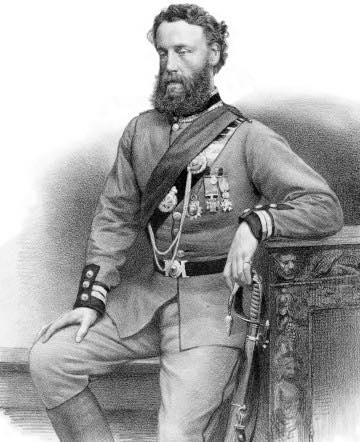
Given misleading information, the Light Division began running back into the advancing Fusiliers. The Scots Fusiliers’ colour party, led by Senior Subaltern Robert Lindsay, aged 22, continued to advance steadily. He called out for the retiring troops to rally on the colours.
Under enemy fire, the colour that Lindsay was carrying was shot through in a dozen places and, at one stage, the staff was cut in two and the colour fell on top of him. He was seen to rise and wave the flag. His example and courage enabled order to be restored until the rest of the Brigade arrived and pushed the Russian troops out of the Great Redoubt and back up the slope.
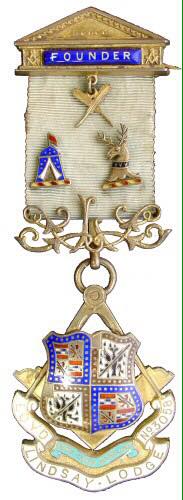
The image shows a founder’s jewel for Loyd Lindsay Lodge No 3058 formed in 1904 and named after one of the first winners of the Victoria Cross, Robert James Loyd-Lindsay (later Lord Wantage). The jewel includes, on the ribbon, the Lindsay family crests of a medieval pavilion tent and a stag’s head. Hanging below the ribbon is a representation of the Loyd Lindsay coat of arms. This is one of the jewels from the Library and Museum’s extensive collection which has recently been catalogued.