Sheffield Freemasonry
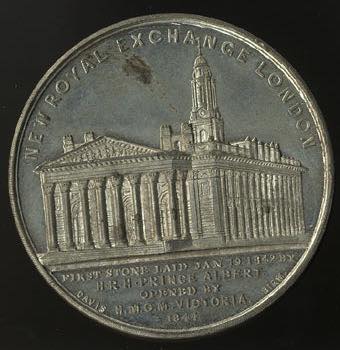
Medal commemorating the opening of the New Royal Exchange London, circa 1844.
Silver coloured metal medal. On the obverse central t the design is a relief depiction of the New Royal Exchange building in London. This consists of; tiered steps, several columns, an entablature and triangular pediment, and a tower. Encircling the top half of this medal is relief text reading ‘NEW ROYAL EXCHANGE LONDON‘. Beneath the design is relief text reading ‘FIRST STONE LAID JAN. 19. 1842 BY / H.R.H. PRINCE ALBERT. / OPENED BY H.M.G.M. VICTORIA / 1844.’
On the reverse central to the design is a relief depiction of a statue of Arthur Wellesley, 1st Duke of Wellington (1769-1852), on horseback surmounting a pedestal mounted by relief letters reading ‘SERINGAPATAM / ASSYE / TALAVERA / BADAJOZ / SALAMANCA / VITTORIA / TOULOUSE / WATERLOO’
Encircling this is relief text reading ‘THE WELLINGTON STATUE IN FRONT OF THE ROYAL EXCHANGE LONDON’. At the bottom of the medal is relief text reading ‘ERECTED / JUNE 18. 1844’.
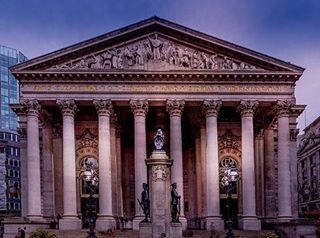
Following a devastating fire in 1838 the Royal Exchange in London needed rebuilding. The New Royal Exchange was designed by Sir William Tite. The foundation stone was laid by Prince Albert on 19th January 1842 and the building was opened by Queen Victoria on 28th October 1844.
Arthur Wellesley, 1st Duke of Wellington (1769-1852) was twice Prime Minister of England as well as an active general who fought many battles. The most celebrated of which is the French defeat at the battle of Waterloo in 1815. He had been made a Duke the year previously following his successes during the Peninsular War (1808 – 1814).
Queen Victoria was born on 24 May 1819 at Kensington Palace, London. She was the daughter of Prince Edward, Duke of Kent and Strathearn, Grand Master of the Antients Grand Lodge in 1813 and fourth son of King George III. Her uncle was Augustus Frederick, Duke of Sussex, Grand Master of the United Grand Lodge of England until his death in 1843. After the death of both King George IV and the Duke of Kent in 1820, Victoria was raised by her German-born mother, Princess Victoria of Saxe-Coburg-Saalfeld. She succeeded to the throne a month after her eighteenth birthday following the death of her uncle, King William IV, in June 1837.
Her coronation was held at Westminster Abbey, London on 28 June 1838. On 10 February 1840, Victoria married her first cousin, Prince Albert of Saxe-Coburg and Gotha, with whom she had nine children. The third of these, Arthur, Duke of Connaught and Strathearn went on to become Grand Master of the United Grand Lodge of England from 1901 to 1939. Following the death of Prince Albert on 14 December 1861, Victoria went into mourning for the remainder of her reign, very rarely appearing in public and choosing to dress entirely in black. She reigned for sixty-three years and died at Osborne House, Isle of Wight on 22 January 1901.
Prince Albert Francis Charles Augustus Emmanuel of Saxe-Coburg-Gotha, (1819-1861) was later known as Albert Prince Consort. He married Queen Victoria in 1840. Prince Albert became an influential advisor to the Queen and heavily influenced her increasing interests in social welfare.
( Taken from www.freemasonry.london.museum)