This article was originally published in The Northern Light and on the Scottish Rite, NMJ website.
In tribute to the United States’ 250th anniversary, we are shining a light on Freemasons who served our country throughout its history. Our fraternity’s legacy is woven into the American story—not just at its founding, but in every era where courage and leadership were required. Join us as we profile ‘Brother Patriots’ from across the decades who proved that a commitment to the Craft and a commitment to Country go hand-in-hand.
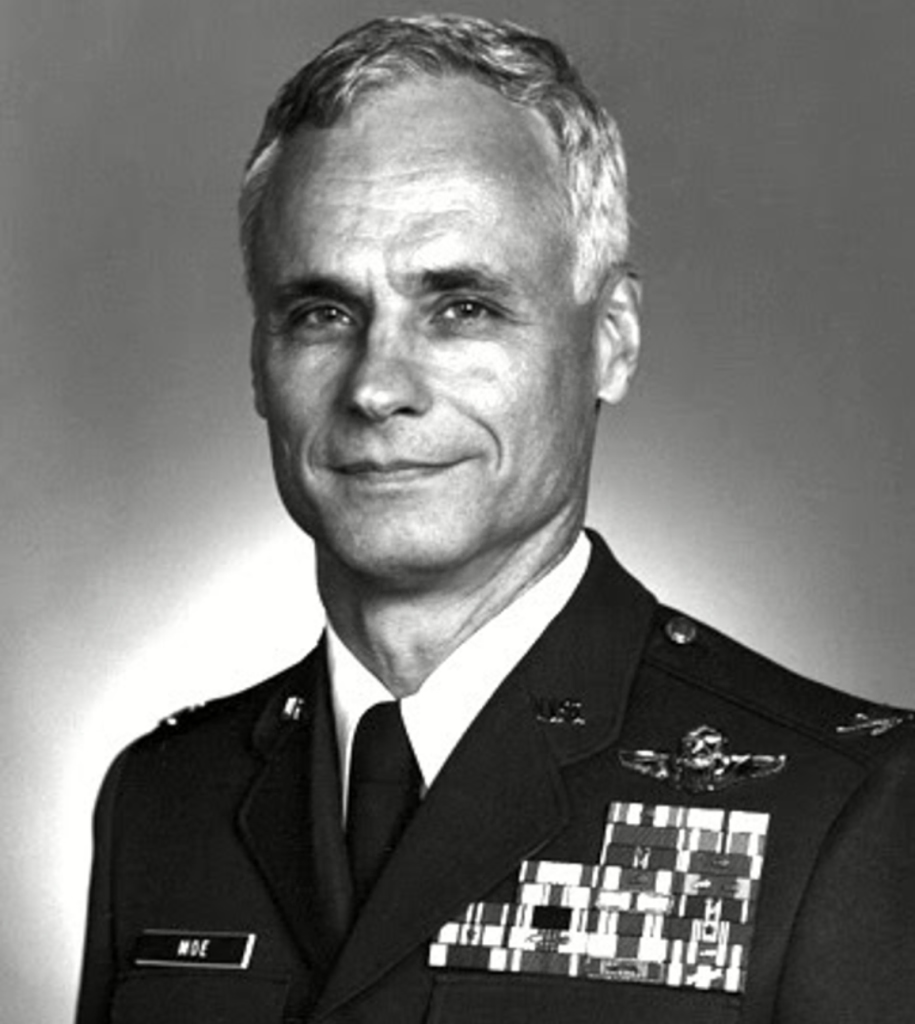
Retired Air Force Colonel Thomas Moe, 33°, is a man defined by courage, faith, and an unshakable sense of duty. A Vietnam War veteran who spent 1,881 days as a prisoner of war at the Hanoi Hilton, Brother Moe emerged from one of the most unimaginable ordeals of the Vietnam War with his integrity and faith fully intact. A recipient of the Supreme Council’s Gourgas Medal and a third-generation Freemason, his story is not just one of survival, but of the values that carried him through.

Brother Tom grew up in Arlington, Virginia in a middle-class family, where his father — a World War II veteran — worked for the Department of the Navy. He ran track, played in a band, and met his future wife, Chris, in that same town. After college, Tom followed his passion for aviation, commissioning through Air Force ROTC and marrying Chris before receiving a pipeline assignment on the F-4 Phantom — meaning he would go to war upon completion of training. Three months before deploying, he and Chris welcomed their first child, Connie.

Once stationed in Da Nang, Tom flew air-to-ground missions targeting enemy supply lines. When pilots began losing planes at an alarming rate — seven F-4s and fourteen pilots in a single week — they suspected faulty bomb fuses and refused to fly with them. Leadership eventually relented, had the fuses tested, and declared them safe. The pilots didn’t believe it, but complied. Those fuses went back into the arsenal just before Mission 85.

Four pilots were chosen at random to fly the first mission with the fuse again. With no faith in it, they briefed a survival tactic — flying high and spreading out. It wasn’t enough. Tom watched his wingman’s plane erupt into a fireball, both crew members ejecting as it tumbled out of control. Seconds later, his own plane was damaged by the blast — no electronics, no hydraulics, inverted. He and his co-pilot righted the aircraft and ejected.
Dangling from his parachute at 18,000 feet, Tom radioed the base: “I want you to know that we just got blown up by our bomb fuses — tell headquarters right now.” Nearby planes dropped their bombs and turned back. That single act likely saved lives.
After landing 40 feet up in a tree, Tom spent nearly 48 hours evading capture — pressing himself against tree trunks as soldiers passed within feet, hiding beneath a fallen log as troops closed in from every direction. Eventually, they saw through his camouflage. Tom emerged to a dozen rifles pointed at his head.
Over the next month, Tom was moved from camp to camp, faking injuries to appear immobile while looking for a chance to escape. Two attempts failed. The early weeks of captivity were manageable — basic interrogations, name, rank, and serial number. “There was no rough stuff or anything. It was easy to resist.”
That all changed when he arrived in Hanoi. For his first nine months at the Hanoi Hilton, Tom saw no one except his interrogators — forced to sit on a tiny stool for days, unable to sleep, freezing through the nights. When offered an early release, he refused. Prisoners leave in the order they were captured. The standoff led to a hunger strike, and when guards discovered he’d been throwing his food away, they tortured him nearly to death.
“Leg irons, handcuffs, a pole behind your elbows. Your neck is tied to your leg irons, and then you’re just kicked and beaten until you’re unconscious.”
To survive, Tom learned to leave his body — looking down at himself from above until the pain was bearable. He built houses in his head, brick by brick, nail by nail. And he prayed. “I prayed for strength. Whatever happened, that’s the way it was going to be.”
Having survived torture to the brink of death, Brother Tom knew that it was he who had broken his captors. From that point, things became more tolerable — a quiet, unspoken live and let live.
In March 1973, Tom spotted a U.S. C-141 fly over the courtyard without being fired upon. Days later, the prisoners were bused to the airport and loaded onto the transport plane. The mood was somber and quiet as they lifted off toward the Gulf of Tonkin.
“There’s an expression that pilots use as they go over the water that’s called feet wet,” he explained. “So, the pilot hits the intercom. Alright, boys, we’re feet wet! And all bedlam breaks loose.” They were free.
Within a week, Tom was home at Wright-Patterson Air Force Base, reunited with his family.

After retiring from the Air Force as a Colonel in 1995, Tom earned a Master’s degree in International Relations from Notre Dame and went on to serve as Director of the Fairfield County Office of Emergency Management and Homeland Security in Ohio. He was later appointed to Governor John Kasich’s cabinet as Director of the Ohio Department of Veterans Services, where he worked to improve state support and resources for fellow veterans. He also remained active in veterans’ groups like the VFW and AMVETS.
A third-generation Mason, Brother Moe was raised in Lancaster Lodge No. 57 and later joined the Scottish Rite in the Valley of Columbus, coroneted a 33° Mason in 2017.
“It’s one more piece of the compass that can help guide you,” he said of Freemasonry. “I like that Masons practice what they preach.”
Interested in reading more about Freemasons who have served our country? Check out this piece on fellow aviator and Brother Jimmy Doolittle.
The post Brother Thomas Moe, 33º: Vietnam War Veteran, Gourgas Medal Recipient, and Proud Freemason appeared first on Freemasonry.
This article was originally published by Freemason.com. Read the full original article here.