This article was sourced in part from the Scottish Rite, NMJ and Illinois Freemasonry.
Freemasonry teaches many of its lessons through stone. Before Masons gathered to discuss morality and self-improvement, stonemasons cut and shaped blocks to build cathedrals, temples, and city walls. Two of those blocks, the Rough Ashlar and the Perfect Ashlar, became lasting symbols in the Craft. Together, they tell one of Freemasonry’s clearest stories about growth.
What Is an Ashlar?
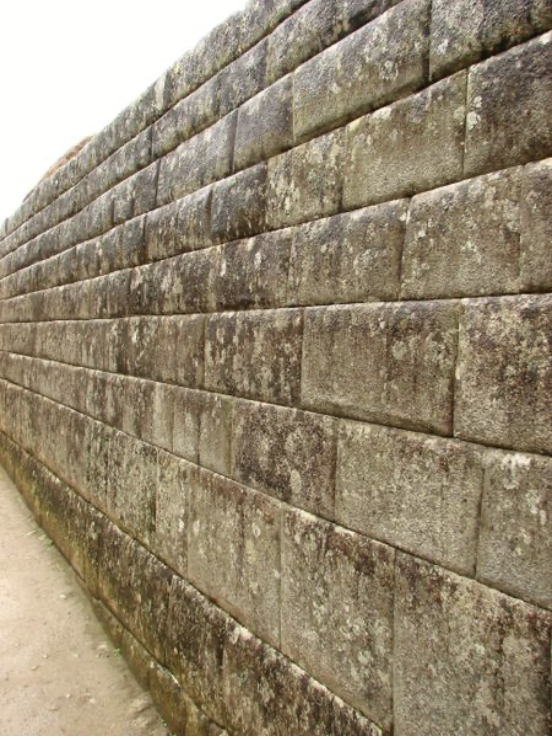
An ashlar is a block of stone cut from a quarry for use in building. Stonemasons smooth it down with chisels until it’s ready to use, and the finished blocks fit together to form solid, sturdy walls.

What does the Rough Ashlar represent?
Ashlars have held a place in Freemasonry for centuries, appearing in lodge inventories as far back as the 1700s. Today, most lodges keep one on display as a nod to those early stonemasons, and as a reminder of the foundation Masonry builds in a man’s life. The ashlar is one of the first symbols a man encounters in the fraternity, appearing to him in his very first degree as an Entered Apprentice. It stands for the change a man goes through as he moves through the Craft. Before he’s initiated, a Freemason is like the rough stone: unshaped, and not yet ready for the work ahead. As he applies himself to the Craft and grows into a man of service and integrity, he takes on finished form.
A vital lesson the ashlar teaches is that our progress should only be measured against ourselves and not others.
No two ashlars are alike, and comparing one man’s journey to another’s only feeds the kind of ego the Craft asks him to set aside.

What is the Perfect Ashlar?
The perfect ashlar represents what every Freemason is working towards. After years of hard work, dedication, and commitment to the Craft, a man is transformed into someone of true value: a Freemason committed to bettering himself, supporting his Brothers, and building something greater than himself. He doesn’t reach it alone. It comes through genuine devotion to his community and his fraternity.
Reaching that state doesn’t mean becoming flawless. The goal of a Freemason isn’t perfection, but usefulness: a man who contributes meaningfully to his community and stands by his Brothers. And he doesn’t shape his own ashlar in isolation. His Brothers, each working on stones of their own, stand alongside him, offering support and encouragement throughout the process.

The Rough and Perfect Ashlars remind us that every Freemason’s journey looks similar at its core: he begins unfinished, and through effort, education, and the support of his Brothers, he shapes himself into something more. The stone doesn’t change overnight, and neither does a man.
Interested in learning more about common Masonic symbols? Explore our blog on Masonic Symbols tied to America’s 250th.
The post Behind the Symbol: The Rough & Perfect Ashlars appeared first on Freemasonry.
This article was originally published by Freemason.com. Read the full original article here.