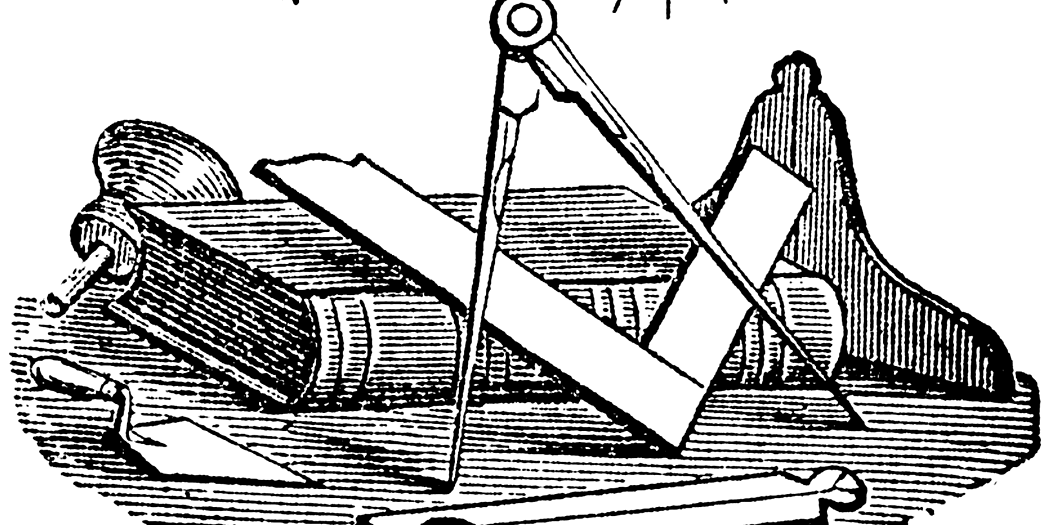
Much has been made of the symbolic significance of the angle, or distance between the points, of the compasses in masonic iconography, both by freemasons looking for deeper meanings, and anti-masons looking for further “proof” of occult association.
Unfortunately for both, a review of the earliest depictions of the compasses, with or without the square, demonstrates a lack of conformity, with a wide range of angles. Although a depiction of the compasses with the points over the edges of a five-pointed star can be found on the west face of the altar in the lodge room of Canongate Kilwinning, No. 2, Scotland [AQC XLII, p. 144.], this usage is rare. Identifying the compasses with the Star of David and fixing the angle at 60 degrees has no historical validity in masonic iconography. In many jurisdictions, the compasses of the Grand Master are set to thirty-six degrees while those of a Past Grand Master is set to twenty-nine degrees.
Within Freemasonry there is a tendency to embellish and add to the simplicity of masonic teachings, ascribing significance where none was intended; mistaking visual mnemonics or artistic license for symbolic depth. Those outside Freemasonry fall into similar errors with the added intent of deprecating that which they do not understand. The following depictions are not exhaustive but certainly representative. Researchers should also note that the square and compasses image officially registered as Freemasonry’s trademark for use in Canada sets the angles at 45 degrees.